


How ‘Standard Work’ reduces complexity

Estimated reading time: 1 minute
We don’t see it coming. What starts as a simple idea quickly becomes part of a torrent of complexity. Before we know it all the good ideas lead to a form of paralysis. In this post, I will argue that trick is to use ‘Standard work.’
Table of contents
As our company grows our well-intended policies and processes for purchasing requests, expense reports, management reports, document submissions, committees, task forces and Annual Operating Plans all pile-up. Lots of emails, meetings and reading. Who has time to do any real work? How do we deal with the necessary bureaucracy?
When 2+2 makes 3
Transaction cost theory explains the formation of companies as a way of lowering the cost of doing business. Simply put, the theory states that it is more efficient to transact within the company than outside of it. In our digital world, I have my doubts that this still is true. When is it easier to get something done inside a large company than outside of it?
I have had my share of large company experience. For instance, working in Amsterdam for a multinational. Like most multinationals, this was (and is) struggling with complexity. Too many business units, layers, stakeholders, titles, structures, processes and business controls. Decision making was very fast at times but implementation across multiple divisions was painfully slow. Lots of meetings and emails. It was very far from being a perfect market of information, as the theory suggests.
Recently, I did an assignment for a large Danish industrial company. Their local offices faced the challenge that aside from servicing their markets they had to embrace a steady stream of new initiatives from HQ. Few initiatives are coordinated or aligned. Global Sales presents new ways of working in the format they like, Global Marketing then approaches the same local employees in new ways. Each time the local offices have to make sense of new, comprehensive material. People are left with new ways of working that they must make part of their daily work. Matrices and reporting lines are growing.
So, while scale economies suggest that 2+2 can be 5, the end result is often 3. What goes wrong?
”If you can’t explain it simply, you don’t understand it well enough.””
Albert Einstein

Too many perspectives and too little common ground
If you look at each new way of working in isolation, then most of them make sense. They are introduced by smart people with good intentions. The trouble is that when companies employ thousands of smart, highly paid people and then place them into the pigeonholes of a corporate hierarchy, then people do what they get paid for. From each of their pigeonholes, they develop intricate systems, structures and processes that they broadcast to their colleagues. It’s not exactly standard work.
Add to this that each function looks at the company from a very different perspective. For the Communications department, it’s all communications. Finance sees everything as numbers. To HR it is all about incentives and training. On top of this, people have different nationalities. In this end, the common ground is not there.
Last week, I talked with the CIO of a large retail chain. He pointed out that people have a habit of blaming the IT system for what is wrong with the business. He had realised that many times it was the business process that was wrong. When the business process is invisible and not clear to employees then what becomes the problem? The IT system, of course.
The end result is an overwhelming amount of demands and information that surpass people’s cognitive abilities. Employees spend more of their time and energy navigating conflicting demands and finding information. The question is how can grow a company without gradually paralysing its employees? This is where standard work comes in.
Standard work can reduce big company paralysis
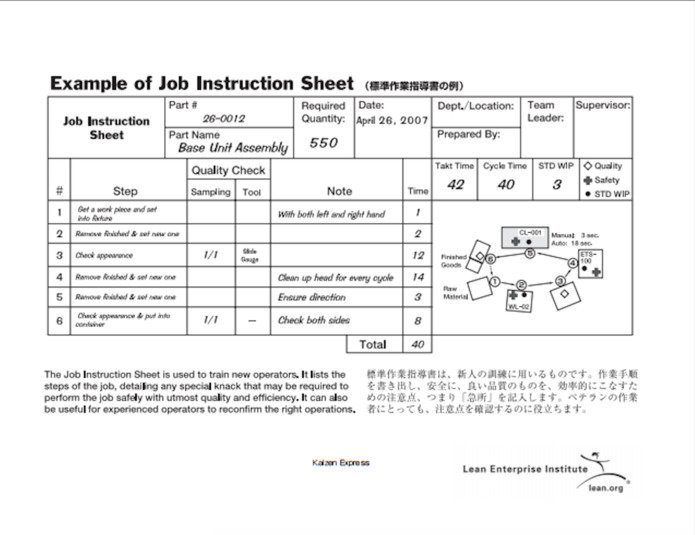
What is standard work? You may ask. Standardized work or standard work is the baseline for continuous improvement. Learn about what are the best process improvement tools and how to succeed with your process improvement plan in our two guides. It is the baseline for how work is done. It shows as standardized business processes and work instructions. This work instruction format ensures that employees can cut through all formatting clutter and unnecessary information to focus on the essentials of doing the job. Now, back to what it can do for complexity.
If we assume that all functional areas, as well as global, regional and local organisations, are important in the company, then how can they be aligned for the benefit of the individual employee? The starting point is a common language that allows the different perspectives to work together across functional silos and nationalities. A common language enables common understandings of company challenges and strategies to address them.
Standard work is the closest thing we have to a common language in a large, complex corporation. The trouble is that business process diagrams often are so complex that they need special training to understand. Quality and IT people design them so they are often too distant from the real life of the business. Sometimes they are also highly rigid and unable to adapt to changes. However, a process hierarchy in the simple form of a high-level diagram that shows how activities flow through departments to the end customer then business processes become a map that can help us collaborate and guide us through complexity.
Examples of features for How ‘Standard Work’ reduces complexity

Reuse processes and activities
Any process or activity can be added to other processes for easy connection.

Automatic change log
Every change to any process or activity is automatically logged and shown in a searchable change log.
Starting out with standard work
To start with standard work, you need a common way of expressing how you work. Employees must see ‘what to do’, ‘who’s responsible’ and ‘how to do it in a common, standard work format. This is where templates and common systems play a part.
👉 Recommendation: Learn how “Standard Work” simplifies complex corporate operations through a common language and standardized processes. Essential for efficiency.
Enhancing your standard work
Couple standard work with a better and clearer mandate for the employee to influence this then you have the first ingredients for a recipe to handle complexity. After this, connect your systems and assets to the activities in the process where employees use them. If you do this consistently across your company then you eliminate some main reasons for the complexity that people experience. In fact, this is how the Gluu platform can support your Lean program.
Other ways of dealing with complexity?
In this video, Eric Berlow provides a useful guide that empowers corporate citizen to further tackle complexity:
Conclusions
“Standard Work” serves as a vital tool in combating the complexity that plagues large corporations. By establishing a common language and standardized processes, it enables effective collaboration and guides organizations through the intricacies of their operations. Embracing standard work is essential for streamlining processes and fostering efficiency in complex corporate landscapes.
Frequently Asked Questions
“Standard Work” refers to the establishment of standardized business processes and work instructions that serve as the baseline for continuous improvement within an organization. It provides a common language and framework for employees to understand how tasks should be performed.
“Standard Work” simplifies complex corporate structures by offering a common language and process hierarchy. It allows employees from various functional areas and nationalities to collaborate effectively, aligning their efforts to address company challenges and strategies.
To implement “Standard Work,” start by creating standardized work instructions that clearly define what needs to be done, who is responsible, and how to perform tasks. Utilize templates and common systems to ensure consistency. Above all, empower employees to influence and enhance standard work, and connect systems to relevant process activities to eliminate complexity.
This post was originally published on December 06, 2018, and revised on June 24, 2021.


